
Imagine reaching into your wardrobe on a Tuesday morning and moving a row of clothes aside to find the one thing you want to wear. You get dressed and leave on time, so it hardly seems worth calling this a problem. Yet the same small inconvenience happens again the next day. If you were arranging the wardrobe today, you might put the clothes you use most somewhere easier to reach. The current arrangement is not necessarily wrong; it may simply belong to a different version of your routine.
That distinction can be useful throughout a home. A system may have worked well when it was introduced, may depend on habits you hope to develop, or may reflect somebody else’s idea of how a room should look. None of those origins makes it a bad system. The question is whether it helps the people using the space on an ordinary day. You can answer that without reorganising the whole house: notice where a task repeatedly takes more effort than expected, then look at the arrangement behind it. The aim is a better fit for life as it is now, not a perfect home.
Three ways a home can feel out of step
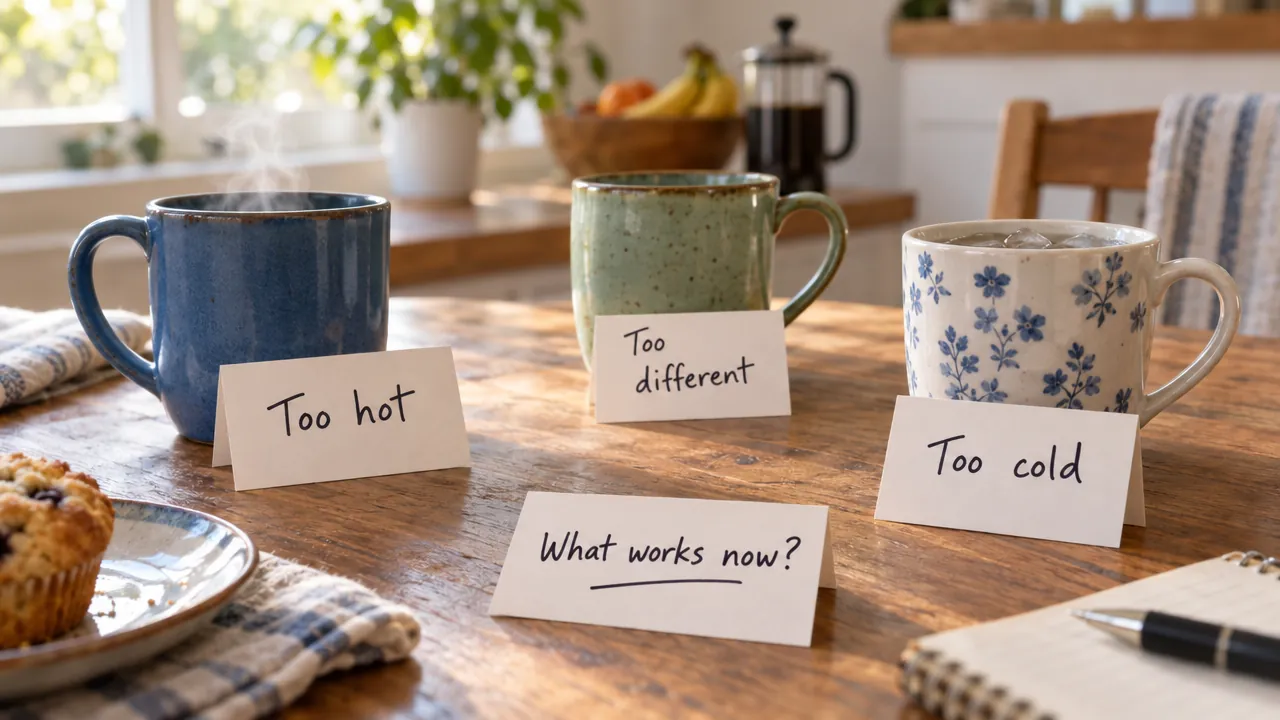
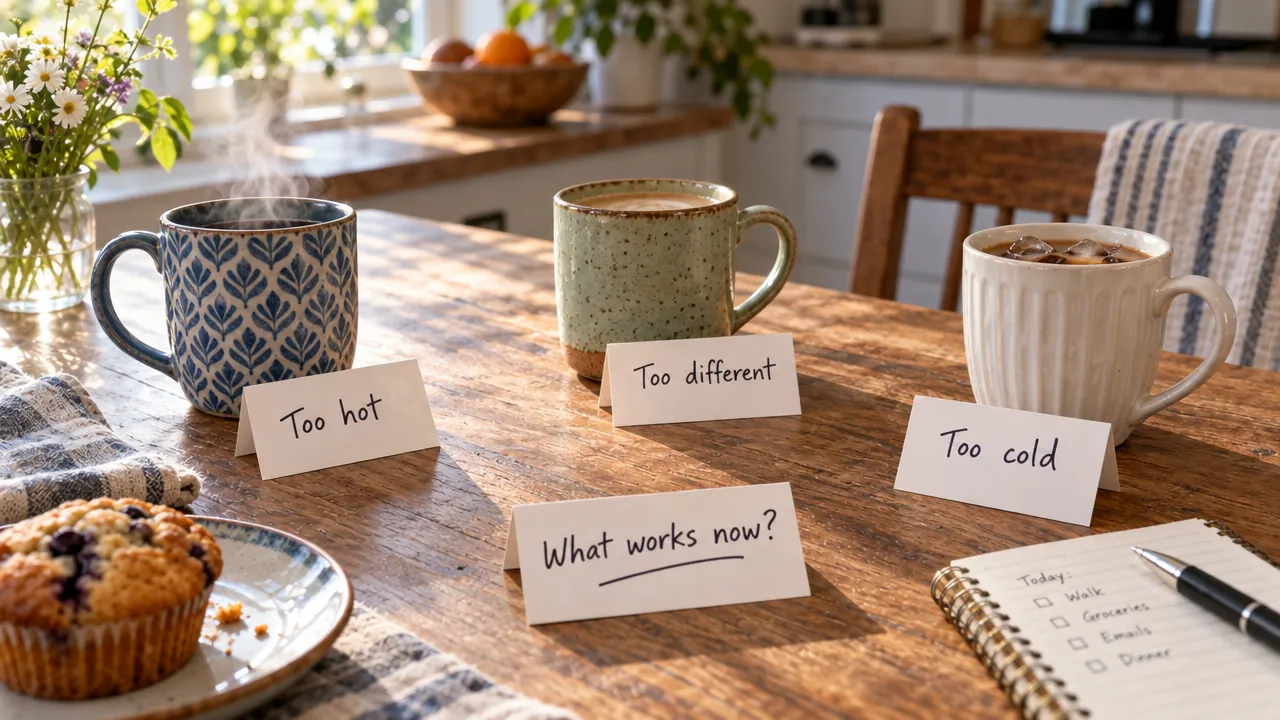
The Goldilocks comparison offers a way to think about these mismatches. A setup can be ‘too cold’ because it still serves an earlier stage of life, ‘too hot’ because it assumes a future routine that has not taken hold, or ‘too different’ because it was shaped by an outside expectation. These are prompts for observation, not labels that need to fit every room. A kitchen, wardrobe or desk can contain elements of more than one pattern, alongside arrangements that already work well. Looking at one task at a time is more useful than trying to assign a single label to the entire home.
Too cold: an earlier routine is still in place
Past arrangements often stay because there was a sound reason for them. A household sets up its storage and divides its tasks around the jobs, ages, schedules and space it has at the time. Once those decisions become familiar, it is easy to keep using them without asking whether their original conditions still apply. The point is not that an older arrangement was a mistake. It may have saved time for years, while now requiring a little more work than it needs to. Familiarity can also make the source of that extra work difficult to see.
- A wardrobe puts clothes for a former nine-to-five job ahead of what you wear in your present working week.
- A morning routine still follows the order that made sense when a child needed help at breakfast.
- Household chores are divided according to working hours that have since changed.
- Storage planned for a previous home has been carried into a different space, where it only approximately fits.
Jobs change; children grow; relationships and routines shift. Someone may move from home working to an office, or the other way round. A change in health may also alter what is convenient. Household arrangements do not automatically change with any of these circumstances. You might continue to put things where they have always gone, even though reaching them now means moving other things first. That repeated extra movement is a more useful clue than whether the storage still looks orderly. A system can look unchanged while the person using it has a quite different day.
A once-reliable morning routine offers another example. If breakfast now happens at a different time, following the old sequence may create a scramble that was not there before. It can be tempting to treat that as a failure to be more organised. First, consider whether the sequence was designed around a day that no longer exists. The same question applies to a chore split agreed when one person worked different hours: does the division still match the household’s present week? The earlier routine was suited to its circumstances; keeping it unchanged is a separate decision.
The ‘too cold’ feeling, then, is not necessarily a dramatic problem. It may be the quiet sense that familiar tasks have become harder, even though the system technically still functions. Updating it need not mean dismantling something that served you well. It means separating the useful parts from the parts tied to circumstances that have passed. You can keep the structure of a routine while changing the part that no longer makes sense.
Too hot: the setup expects a future habit
Other arrangements are built around a hoped-for routine. You may picture yourself batch cooking, dealing with paperwork as soon as it arrives, maintaining a carefully folded wardrobe or sitting down to focused work at a particular desk. You might also plan a smooth morning and a quieter evening. There is nothing wrong with wanting any of those things. Trouble can arise when the space works only if that imagined routine happens consistently, while the people living there still need to use it on less orderly days. An intention is not yet the same thing as an established habit.
- A filing system depends on every letter being sorted immediately, although that rarely happens.
- A wardrobe stays tidy only if each washed item is folded and returned in exactly the planned way.
- A reading corner takes up space for a reading habit that has yet to become part of the week.
- A home office is laid out for long, uninterrupted sessions, although current work rarely happens that way.
These ideas may suit another stage of life, and parts of them may already be useful. But if a filing system is not being maintained, the papers still need somewhere to go today. If the wardrobe arrangement comes apart each laundry day, getting dressed may become another small task of putting the system back together. A meal-planning board left blank for months likewise takes up attention without helping with this week’s meals. In each case, the intended routine and the lived routine have drifted apart. The arrangement asks for consistency that everyday life is not currently providing.
That gap can make an unfinished intention unusually visible. You pass the unused reading corner, the unsorted papers or the blank board and are reminded of something you meant to do. The reminder may feel discouraging even if the original idea still appeals to you. It is possible to value the intention without requiring your current home to behave as though the habit is already established. Ask whether the arrangement makes today’s task easier. If its usefulness depends entirely on becoming more consistent later, it may be worth simplifying for now. That leaves the possibility of revisiting the idea if your routine changes.
A ‘too hot’ setup does not mean giving up a goal. It means allowing the present routine enough room to function while that goal remains a possibility. The distinction matters: an aspiration can be kept without making every ordinary weekday a test of whether you have reached it yet. What helps today need not be a final decision about how you will live later.
Too different: someone else’s preference leads
A third kind of mismatch has less to do with time. You may copy a layout because it looks appealing in another home, perhaps in a social media image, or arrange a shelf because someone else says that is the proper way to do it. The result might be attractive and still be inconvenient for you. A pantry display of matching, labelled containers, for example, takes effort to keep as arranged. If that effort does not suit the way you use the kitchen, the display is not serving its purpose in your home. Looking neat in a picture and being manageable on a busy weekday are different tests.
Think of being offered porridge made with milk, berries and honey when you actually prefer it plain and made with water. The decorated bowl may look inviting to someone else; that does not change your preference. A home can work the same way. A room does not have to resemble an image you admire or meet somebody else’s standard to be comfortable to use. It needs to reflect what the people living there do and like, in both its appearance and its everyday function. An arrangement that pleases a visitor may still make a repeated task awkward for the person who lives with it.
This does not rule out taking ideas from other people. It gives you a way to judge those ideas after trying them. If you regularly have to work around an arrangement, ask whether you chose it for your own routine or for how you thought the space ought to look. A setup can be entirely suitable for someone else and still be the wrong fit for you. The useful question is not whether the idea was good in its original setting, but whether you want to maintain it in yours.
Why the mismatches can be hard to spot
Each kind of setup has a reason to stay. Changing an old arrangement may feel wasteful because it once worked, or bring a sense of guilt about letting it go. Scaling back a future-facing one may feel like admitting failure or abandoning an ambition. Letting go of an admired layout may feel like neglecting advice you trusted or a standard you thought you had to meet. Those reactions can make a practical question feel larger than it is. You do not have to decide whether the past was wrong, the future is impossible or someone else has poor taste. You only have to decide whether a particular arrangement helps now.
Different rooms may tell different stories. A wardrobe might still be organised around an old job, while the home office is arranged for work sessions you hope to have later. An old chore split might sit alongside a meal-planning system that never quite gets used. In the kitchen, a neat shelf might be maintained chiefly because it looks as though it should be neat. None of this requires a single explanation for the whole house, or a project to change every room at once. Some parts may suit the present perfectly well and need no attention.
It helps to pay attention to ordinary friction rather than waiting for a major problem. Notice what you have to move out of the way, which routine needs repeated effort to maintain and which area is inconvenient each time you use it. Then ask a narrower question: is this difficult because the setup belongs to an earlier routine, assumes a future one, or follows a preference that is not yours? Sometimes the answer will be none of these. A rushed morning, for example, does not prove the room is badly arranged. The question is useful because it lets you look more closely instead of blaming every awkward day on the house.
What a better fit might look like
A home arranged for the present does not have a prescribed appearance. It might not impress a visitor, and it need not look identical across rooms. Its useful feature is that everyday actions make sense where they happen. Things can go where you naturally put them, rather than where a more elaborate system says they ought to go. That is not a rule that everything must be left wherever it lands; it is a reason to consider your actual habits when deciding where things belong. The answer will depend on the people using the space and on their current days.
For the kitchen, that means considering how you cook now, not how you cooked two years ago or how you imagine cooking with more time. For a wardrobe, it means looking at the clothes that suit your current job, body and typical week. For a morning routine, it means starting with what really happens on a weekday. A method that works only on a quiet Sunday may not be the method you need for a busy Tuesday. Ease on an ordinary day is a more helpful measure than how orderly a system looks immediately after you set it up.
The same test applies to storage, chores and workspaces. Can you use the arrangement when you are tired, without first restoring it to an ideal state? Can the people who share the home follow it within their current schedules? If not, that observation is information about the setup, not a verdict on anyone’s effort. A simpler arrangement that is used may be more helpful than an intricate one that repeatedly needs catching up. It need not erase what worked before or prevent you from trying something different in the future.
Start with one small adjustment
Begin by asking whether an area has been arranged for the people who use it, rather than for an outside idea of what it should be. Then consider its ‘temperature’: is it holding on to a former routine, relying on a future habit, or already fitting the present? You can do this room by room and system by system. Looking at one source of repeated inconvenience is more manageable than treating the entire home as a problem to solve. It also lets you leave the arrangements that are working alone.
- Notice a task that regularly takes extra effort, such as getting dressed, handling incoming paperwork or starting the morning.
- Look at the arrangement involved. Ask when it was set up, what routine it assumes and whose preference shaped it.
- Keep what still helps. If part of the setup belongs to an earlier life, consider a small update rather than removing the whole system.
- If it depends on a habit you have not developed, make room for the way you currently do the task. If it reflects somebody else’s preference, decide whether that preference also works for you.
For the wardrobe in the opening example, the first question is not whether you need a new storage system. It is why the clothes you wear are behind those you reach past. Perhaps the front section reflects a former working week. Moving the clothes used now into the easiest-to-reach position would address that specific friction while leaving anything else that works alone. The change is small, but it tests the right question: does this arrangement make getting dressed easier in the life you have? You can judge it by what happens on subsequent ordinary mornings, rather than by whether the wardrobe looks newly organised.
Another area may call for a different response. If a filing method depends on sorting each letter the moment it arrives, notice whether that is a routine you actually follow before insisting on it as the only way to keep paperwork in order. If the household chore split was agreed around different working hours, look again at the present schedules. If a carefully arranged pantry shelf needs constant attention, consider whether that attention is worthwhile to you. These are examples of adjusting an assumption, not instructions to achieve a particular-looking room. The relevant detail is the repeated effort, and whether the setup still justifies it.
There is no need to settle every question in one pass. An old system may have useful parts, and a hoped-for routine may eventually become realistic. What matters today is not making the home perfect or ruling out future change. It is noticing when a setup asks you to work around the past, an imagined future or another person’s tastes, then making one deliberate adjustment towards what fits now. As with the porridge in the Goldilocks comparison, ‘just right’ is not decided by how appealing an option looks to someone else. It is judged by the person who has to live with it.