
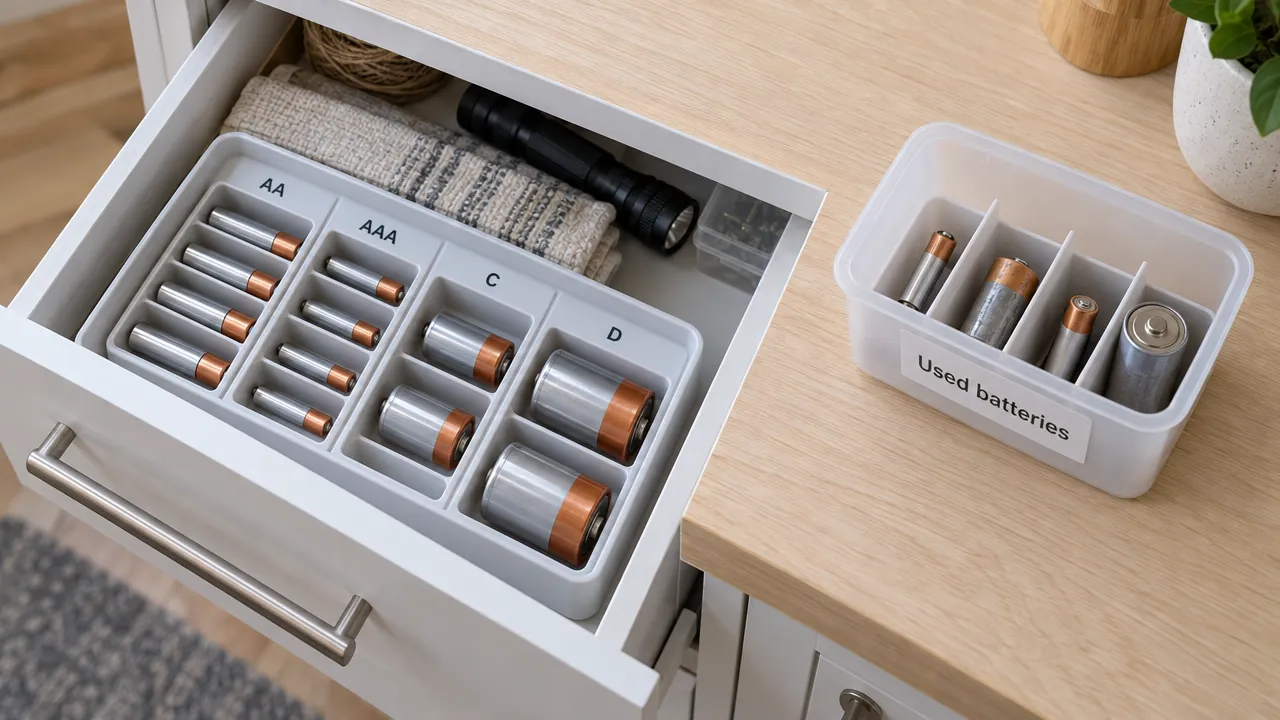
A smoke alarm starts chirping, but the replacement battery is nowhere to be found. The right size might be buried in a drawer, or the battery you eventually find might already be flat. A simple storage arrangement makes both problems less likely. The aim is not to build a large stock: it is to know which sizes you have, where they are and which batteries are still intended for use.
Battery storage also needs more thought than putting everything in a tin. Loose batteries can touch one another or metal objects, creating a short-circuit risk. Keeping them separated, dry and easy to identify helps make a small household task more manageable without requiring an elaborate system.
What goes wrong with loose battery storage?
A single drawer may seem convenient until you need a particular battery quickly. If it also holds keys, coins and used batteries, finding a usable replacement becomes harder. The main issues are separation, size and knowing what has already been used.
- Terminals can make contact. Loose batteries may touch terminal-to-terminal or come into contact with a metal object such as a coin or key. That can cause a short circuit and presents a fire risk.
- Sizes become mixed. When AA, AAA, C and D batteries share an unsorted space, finding the one needed for a remote or a smoke alarm takes longer than it should.
- Charge is unclear. Looking at or feeling a battery does not reliably show whether it still has charge. A battery left loose in a drawer may be difficult to distinguish from one that has already failed.
- Used batteries drift back into circulation. Without a separate place for them, batteries set aside for recycling can end up among new or usable ones. The next replacement you pick up may then be flat.
A useful arrangement addresses all four issues: it keeps batteries apart, gives each size a recognisable place and provides a distinct container for those awaiting recycling.
Plan around the batteries you actually use
Before choosing a container, look at the sizes and quantities your household needs. A large organiser is not automatically more useful than a small one. The choice depends on what you store, the space available and whether you want to carry batteries to another room or leave them in one place.
- Separate individual batteries. Compartments or slots help prevent terminals from touching. They reduce the chance of a short circuit, although they should not be treated as a guarantee that every risk has been removed.
- Give sizes their own places. Divisions for AA, AAA, C and D batteries make it easier to see what is available. You need only allocate space to sizes your household actually uses.
- Match capacity to demand. If you normally use only four AAs at a time, storing forty for an unspecified future need may take up unnecessary room. The same applies to keeping C batteries when you have no regular use for them.
- Consider where the container will live. A larger multi-compartment organiser may fit a spare drawer or cupboard. If drawer space is limited, a smaller container or a wall-mounted dispenser may be a better fit.
- Decide whether charge testing would help. A battery tester can be kept alongside the storage container or built into some boxes. It can help you check a battery rather than judge its charge by appearance.
- Reserve a place for used batteries. A separate, clearly labelled container reduces confusion between batteries ready to use and those waiting to go to a recycling point.
Storage options and what each one does
The main differences between storage options are capacity, portability and how they divide batteries. Some provide a place for several sizes in a drawer; others use wall space or include a tester. A separate used-battery container serves a different purpose and can be paired with any arrangement for batteries still in use.
Caddy-style organiser
A caddy can be carried around the house when a replacement is needed. Its individual compartments give different sizes, including AA, AAA, C and D, their own places and help keep terminals apart. Many caddy-style organisers can be stacked or fitted into a drawer, so the batteries need not occupy an open shelf. This format suits a household that uses a mixture of sizes and wants to keep them together in one accessible place. Check that the compartments match the batteries you actually keep rather than choosing capacity for its own sake.
Wall-mounted dispenser
A wall-mounted dispenser can sit on a wall or inside a cupboard door. Batteries stand upright in separate slots, and one can be taken out without tipping out a whole box. Because it does not use a drawer or shelf, it may suit a home where those spaces are limited. Dispensers commonly have slots intended for particular battery sizes, so this format can be especially convenient when you keep several of one size. It is a fixed storage point, unlike a caddy that can be carried to wherever a battery is needed.
Box with a built-in tester
Some storage boxes divide batteries by size and include a tester in the lid or base. This combines sorting with a way to check whether a battery still has charge, without having to find a separate tester. It may be useful if batteries of uncertain charge tend to find their way back into storage. A separate tester kept near an ordinary organiser serves the same checking purpose; the built-in version is a convenience, not an essential feature of safe storage. Either approach is more informative than deciding from a battery’s appearance alone.
Separate container for used batteries
Keep batteries that are finished with in a small, clearly labelled tub or tin away from those intended for use. This gives them a destination as soon as they are taken out of a device and reduces the chance that a flat battery goes back into the main organiser. The container also makes it easier to gather them for a trip to a recycling point. It need not match the container used for new batteries: its job is simply to keep the two groups distinct until the used batteries can be taken for recycling.
Why a loose pile is best avoided
A drawer or tin full of loose batteries is an easy default, but it does little to keep terminals apart. Batteries can roll against each other or touch a coin or key, with the possibility of a short circuit and a drawer fire. The pile also hides sizes and makes it harder to keep used batteries out of the usable supply. If that is how yours are stored now, focus first on separating and sorting them. A compartmented organiser, suitable slots or another arrangement that keeps individual batteries apart addresses the central problem more directly than a single shared tub.
Common questions
Should batteries be kept in the fridge?
No. The idea that cold storage extends battery life is a myth in this context, and condensation can lead to corrosion. A dry place at normal room temperature is the simpler choice. Keeping the storage place consistent also makes the batteries easier to find when a device needs a replacement.
Can you tell whether a battery has charge without a tester?
Not reliably by looking at or feeling it. A separate tester, or one built into a storage box, can help check a battery whose charge is uncertain. Keeping batteries known to be used in their own labelled container avoids much of the guesswork before testing is even necessary.
Where can used batteries be recycled in the UK?
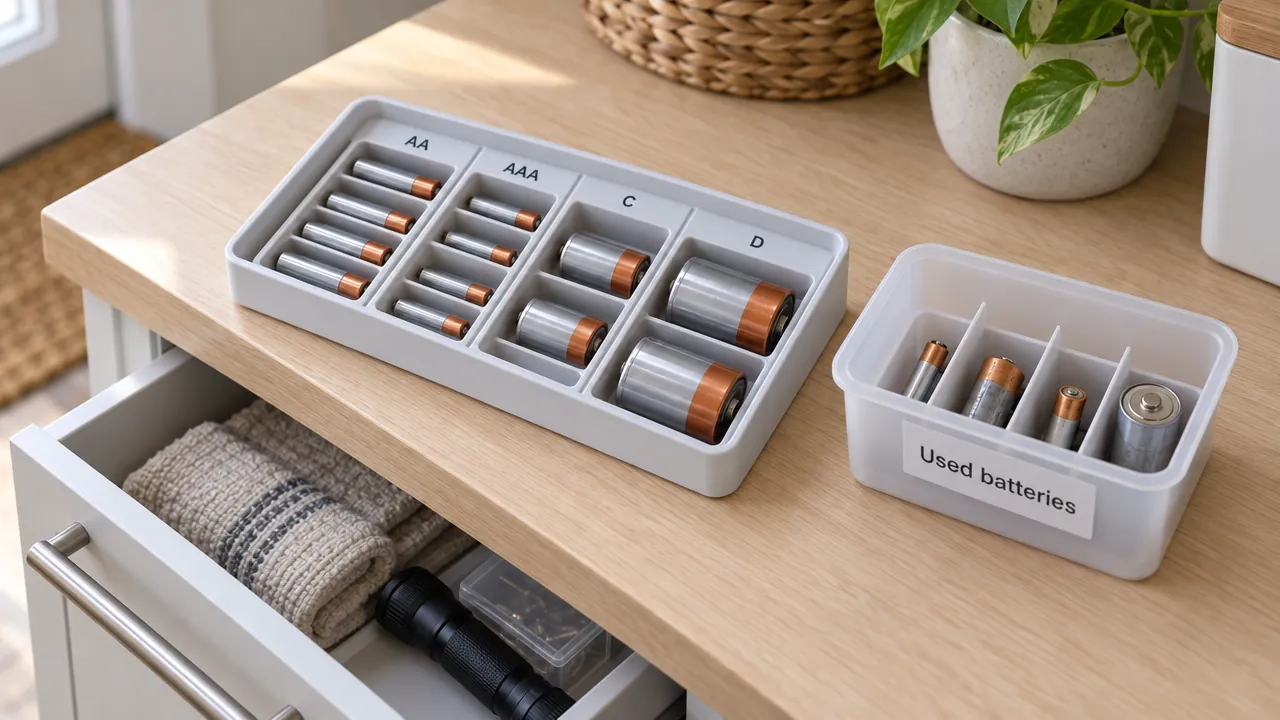
Most large supermarkets have a free battery collection point, often near the entrance or customer service desk. A separate container at home lets you gather used batteries and take them to a collection point during a usual shopping trip. They should not be put in the ordinary household bin.
Is it safe to keep different brands together?
The brand name is not the key storage issue. What matters here is preventing terminals from touching and avoiding confusion between batteries that are new or still usable and ones that are used. Batteries from different brands can be kept in the same organised storage area if they remain suitably separated.
A simple arrangement to maintain
For many households, the useful starting point is a drawer-style organiser with spaces for everyday sizes, alongside a separate labelled container for used batteries. Where drawer space is scarce, a smaller container or wall-mounted dispenser may make more sense. A built-in or separate tester is an option if uncertain charge is a recurring problem. The system need only fit the batteries you use and the space you have: keep sizes recognisable, terminals apart and used batteries ready to take for recycling.